Tuesday, 2 October 2012

Randomness!

There are just a few random pictures that I either missed putting in my blog earlier or there wasn't really space. So here goes!

During our orientation we had a visit from our next door neighbor who is an Imam, or religious leader in Islam. The girls had to cover their heads and shoulders out of respect for him. On a day to day basis us girls have to cover our knees when we go out in public, but we do not need to have our heads covered at all times. Times when we do need to cover our heads would be for religious reasons like when go into a mosque. Most of the time people understand that we are Americans so they do not make us cover our heads when other people do (like Madeleine teaches at a Muslim girls school, but they do not make her cover her head even though the other teachers need to).

I mentioned earlier that traditionally in The Gambia people eat out of communal bowls or plates and sit on the floor to eat their meals. They use their right hand to eat usually, but when we are around people often give us silverware because they know we are not used to this. This is a picture of Kyle, Madeleine, Baboucarr and I eating lunch in the traditional way. The food is placed on a cloth or newspaper, everyone sits around it and then begins the meal. The dish itself is typically rice with some meat, sauce and vegetables in the middle. You are supposed to eat from the outside of the plate and work your way in. Everyone has their own space in the plate and it is rude to eat form someone else's space (the space is determined by where you are sitting). If you'd like to eat some meat or vegetables  you are to use your hands to place it in your space, take a piece off and then place it back in the center. As you can see there is a very specific way to eat communally, it is not just every man for himself. This picture was taken at the art village and this is when we learned the proper etiquette for this way of eating. Since then we have had a few opportunities to use our knowledge and I'm sure we will have much more!

We have met some other tubabs since we've been here. Two were Canadian students of Baboucarr Jallow and one was a previous St. Mary's student who came here through the program we are in and now he is in the Peace Corps here. He came to visit Happy Camp and told us about all the wonderful places to eat and go out. In this picture the group (minus me because I'm taking the picture..) is outside of Omar's, one of our favorite places to eat. It is traditional Gambian food, but sometimes he has Western dishes as well like quesadillas or pizza. As you can see it's a little hut where the kitchen is with outside seating. Peace Corps is written all over the hut because Peace Corps volunteers helped him to build it and the Peace Corps continues to be a major part of his customer population. The food is so delicious and so cheap (one American dollar for a plate FULL of food).

Please ask questions that you may have! About anything! I am more than happy to answer any! Also leave any comments or suggestions. If there's anything you'd like to know more about, or explained further please let me know. Thanks for reading :)


Sunday, 30 September 2012

Attaya 101

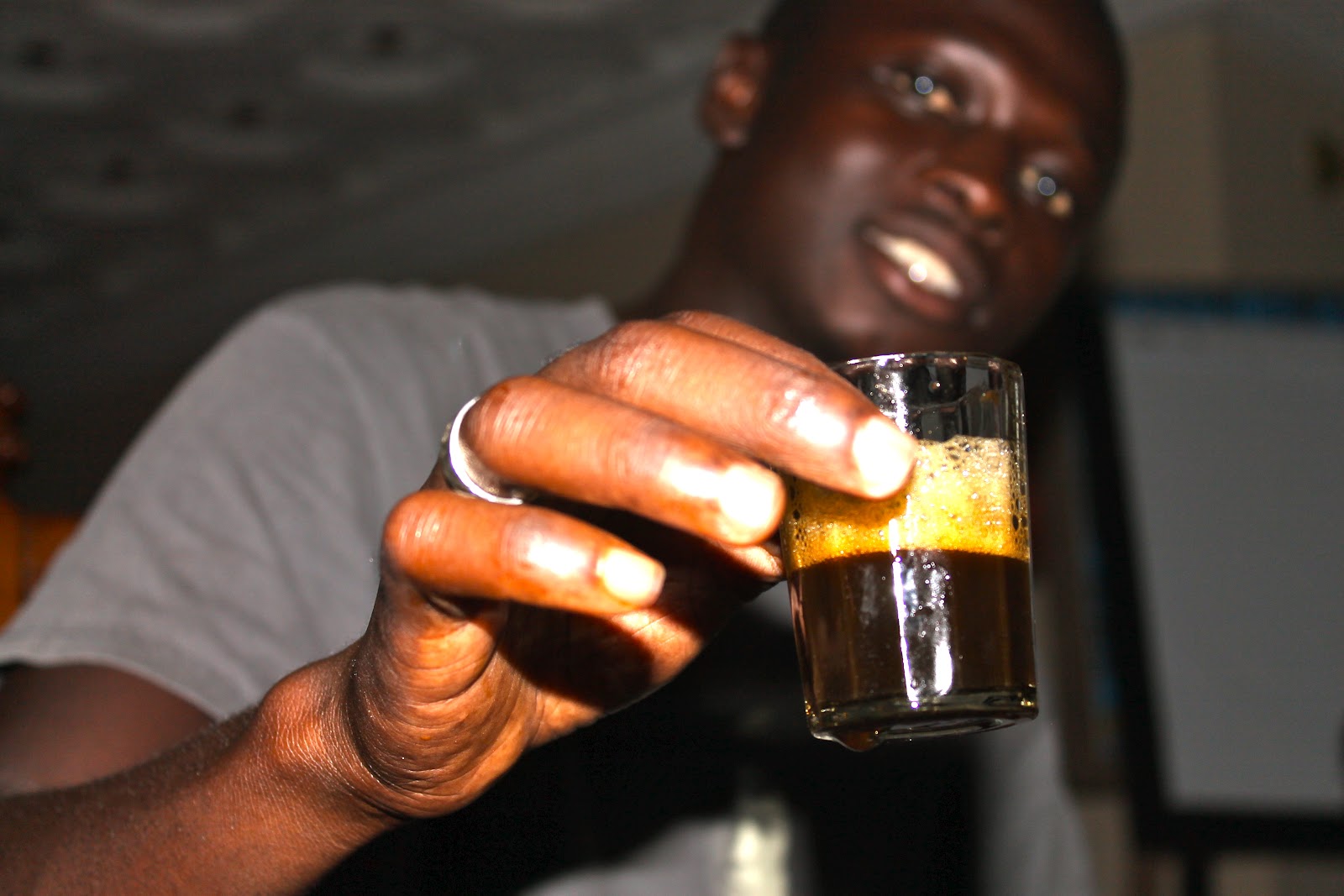
This is Malayan, our day watchman and friend. One rainy Saturday he taught us all how to brew attaya which is very popular in The Gambia. We had drank attaya before during orientation, but did not know how to make it. Simply put attaya is tea, even though the process of making the attaya is more important than the tea itself I'm still going to try and explain it. We have a gas stove here (side note: we don't have an oven so we can't bake goodies :( ) and that is what Malayan is posing with here. There is a tea pot on the stove and he's holding an attaya glass. this is the general set up. People usually brew attaya outside, but since it was raining our lesson was indoors. People will brew attaya along the side of the road or outside their house and anyone who walks by is welcome to join the attaya party.

Brewing attaya is an intense process. You put lots of Chinese Green Tea and a lot of sugar in the tea pot along with water then brew it. This is what it looks like while it's brewing which is pretty gross atually haha but it ends up looking better I promise! As you can see it's not tea bags like most people are used to in the states, but actual tea leaves called warrga here. Gambians add LOTS of sugar. Attaya glasses full. They are known to add a lot of sugar to anything and look at us Americans funny when we only ask for a scoop of sugar in our coffee or no sugar at all.

The more bubbles in the tea the better so you have to pour it from one glass to another (like Malayn is doing here) in order to get the bubbles. Then you pour it back in the pot and brew it some more and then you repeat the process. Like I said it's more about the social aspect so while this long process is going on people (mostly men) sit around the pot and discuss sports or anything in general. 

This is the finishing product! You are supposed to add more water to the pot after the first "batch" of attaya is made to make another "batch" and you're to do this three times. So the first round is stronger and then it gets weaker each time. Depending on how fast people move brewing attaya could take hours. If you want to know more about it click here!

Tuesday, 25 September 2012

Wait we have to go to school?

So it's not all fun an games here in The Gambia, believe it or not we actually have to go to school and work as well... We registered for classes (which took a whole day) during our orientation period. My schedule is as follows:

Mondays and Thursdays 9:30 to 10: 45 - Sociolinguistics
Mondays and Thursdays 11:00 to 12:15 - Poverty and Development
Wednesdays 12 to 1:30 - Africa in the Diaspora

I'm pretty excited about it. I took Archaeology of the African Diaspora at St. Mary's so I am interested to compare the two courses. In general I'm excited to experience college courses outside of the U.S.

So the week after our two week orientation is when classes "began." I say "began" because things rarely begin on time here and it is a known problem at University of The Gambia (UTG) especially for the first week of classes. So needless to say I went to class Monday, Wednesday and Thursday the first week, but I did not have one single class. There are so many little things that went wrong it's not worth saying them all, but I'll try to list of events to give you an idea of what it was like that first week of school:
  1. Fortunately since there are 4 of us going to school Mondays and Thursdays we had a van take us there (it's about 40 minutes away depending on traffic and how fast the driver drives)
  2. We went to the International Relations Office so one of the assistants could show us where our classes are
  3. There were people everywhere trying to get to class or sitting around. We went to Sociolinguistics first cause 2 of us are taking that class. Another class was in the classroom we were supposed to be in.. 
  4. We found the "teachers aid" luckily who had us put our name on a list to say we showed up to our first "class"
  5. Since I didn't have class we went to the library to read (the other two students had real class)
  6. At 11 we went to find our second class of the day, again there was another class in our classroom
  7. So we got to go home early, but it made me worried for the rest of the year
  8. On Wednesday there was no sign of the teacher or classroom for Africa in the Diaspora.. We found a very nice staff member to call our professor for us. The professor told her that the school had gotten the schedule wrong. We got his phone number and we called back and forth multiple times. Eventually he decided to stick with the original schedule...
  9. Thursday was the same thing as Monday
  10. But finally on week 2 I had "normal" classes. It's always up in the air where the classroom will be and I'm still confused as to how the UTG students always know where to go, but I'm catching on to the pattern myself now (it's week 3 already!). You just have to stand outside the classroom it's supposed to be in and wait for the professor or other students to tell you what to do.
Well I hope that wasn't too confusing and you can kind of catch on to what it was like at the beginning. I love all my professors; two males and one female. All three are African but I believe my female professor is form Senegal and the other two form The Gambia. 
The cafeteria at the university is good also and very cheap (about one American dollar for a meal) so thats convenient. And the university is very easy to navigate now that I've been there a few times.

Unfortunately this was a lot of words and not a lot of pictures :( I don't have any photos of the university. But here's the website if you want to know more about it! http://www.unigambia.gm/

Sunday, 23 September 2012

Juffure and Kunta Kinteh Island

This is a picture of us on the boat traveling to Kunta Kinteh Island from Berefet!

This is the view of Kunta Kinteh Island (previously known as James Island) from the boat. It's a very small island where slaves were kept before they were shipped off to the Americas. It became famous through Alex Haley's book Roots. It is said that his ancestor, Kunta Kinteh, was kept here before being shipped off to a port in Annapolis, Maryland, USA then sold to a plantation owner from Virginia. This is why it was renamed Kunta Kinteh Island. Roots is also a popular television mini series if you are interested in watching the series or reading the book to find out more about this.

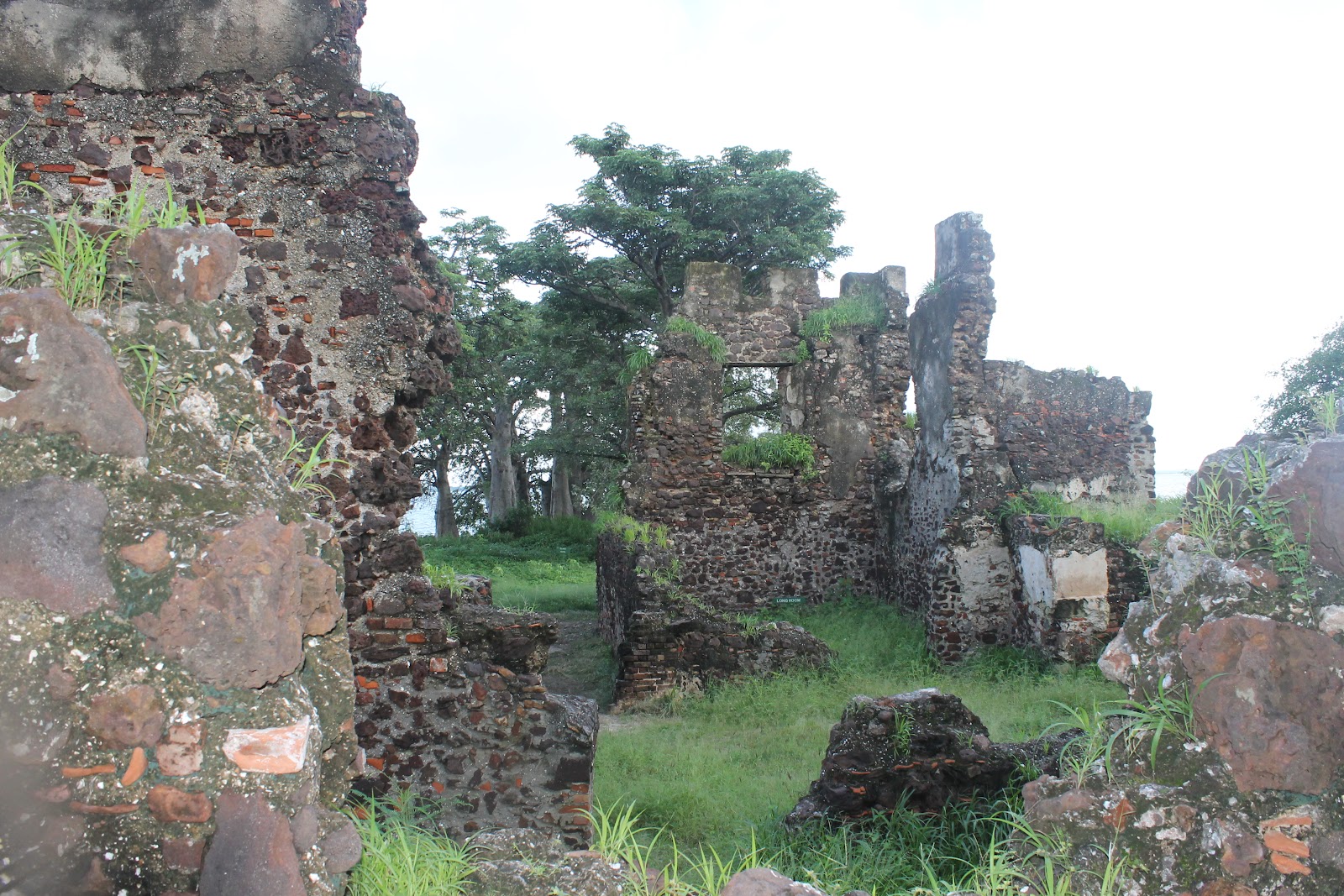
This is part of what is left of the fortifications on the island. After it was used for the slave trade the fort was used as a court house where laws regarding the abolition of slavery were put forth.

This is a small room where slaves who misbehaved would be kept. They'd fit 20 men in this room and give them enough food for only a couple. It was not a pleasant place to be kept. If you'd like more information on Kunta Kinteh Island here is a link to some information provided by UNESCO. The island is very small, but it was a very powerful spot and holds a lot of powerful history.

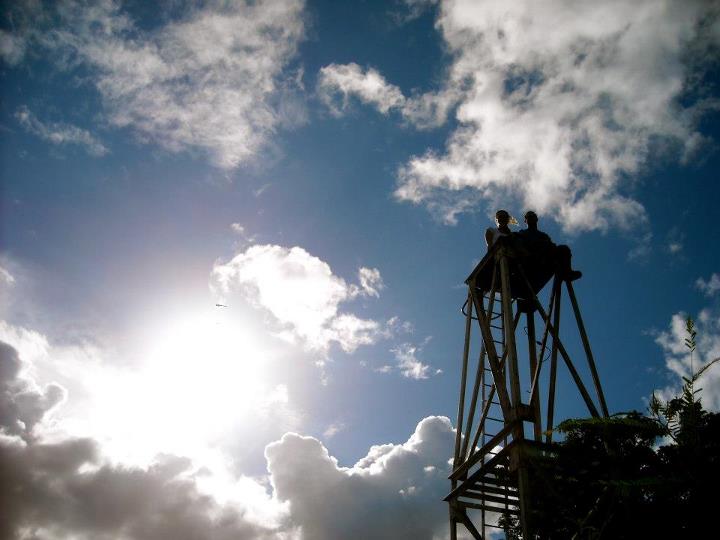
My friend Sam and I climbed to the top of this tower where there was a beautiful view of the whole island.

 This is one of the first things you see when arriving at Juffure. It is only a few minutes boat ride form Kunta Kinteh Island. It is the town on the mainland where Kunta Kinteh is said to be born. This is an amazing statue erected to signify that slavery shall never happen again.


This is the group outside the Roots Heritage Trail. This is said to be the last trail that slaves walked on Juffure before being taken to Kunta Kinteh Island and then the Americas. It was a long walk past rice fields and river. 

Getting back on the boat was an adventure...

 ...but there was a beautiful sunset over the River Gambia upon our departure. The sunset boat ride was amazing, but we all knew it was imminent that we would eventually be boating in the pitch black. There were no lights on the boat, no civilization for miles and they did not have any navigation tools. I was nervous to say the least, but knew what was coming and tried not to think too hard about it. When the stars starting coming out it was absolutely beautiful. At first there were only a few, but then all of a sudden there were thousands. I couldn't spot a moon anywhere (making it even darker) but for the first time ever I saw the milky way. We were all in awe. It had been a frustrating weekend with not much to do and the boat ride had to be pushed back hour after hour. But this made it all worth it.


Friday, 21 September 2012

Up country in Berefet


Berefet is a village up country (about 2 and a half hours up country from Happy Camp). We got to meet the akolo of the village who is the village elder and many other families in the village who were very kind. We also visited the school. Berefet also has an eco village lodge where people can come and stay. They mostly have Peace Corps volunteers and students of archeology stay in the eco village with the very occasional tourist. Our experience at the eco village of Berefet was very interesting. This is a picture of the restaurant/main house of the eco village.

This is what the guest houses in the eco village look like. They had two rooms per house and two beds per room.

This is a close up of one of the houses we stayed in. We were taught how to do the monkey dance by our language and culture teacher Daniel and that's what we're doing in this photo. The dance is you make this pose then squat and repeat the action. We make people do the monkey dance if they do something "bad" (like curse) as a joke. We look pretty crazy tho..


Inside the houses was very different than we're used to. Dirt floors and our bathroom was very bleak. The toilet didn't work and the shower spat at you loudly which was scary, but it's better than a hole in the ground (which happens) and buckets to bathe in. It put Happy Camp in perspective though. We used to always get frustrated when the power was out, but we only had power for an hour a day here plus the other accommodations made us very thankful for Happy Camp. And Berefet is just the beginning so we'll be experiencing other villages that are even less luxurious.

Kaylie and I took a walk to explore around the village. We had a lot of free time during our trip.. Along the way we came across a lot of cute goats and HUGE trees. We even saw some monkeys!


Berefet is just off the River Gambia on a side body of water so it has a beautiful view. We had a lot of free time to explore the small area, but found some good views. From Berefet we took a boat ride to Juffureh and St. James Island!


The Beach!

The first time chance we got we went to the beach. 


Little did we know the first chance we got would be on the rainiest day so far. A few of us still went swimming and the water was like a bath. It was rainy and windy when we got out, but it actually felt really good to be cold! And I would not ever say that in America.. I'm not much for the cold. But here any moment it's cold is a good one. It was the same day as our naming ceremony so getting out of those hot, constraining clothes and into a bathing suit then jumping in the ocean felt like heaven.

The beach we went to is called Lebayto. It's a tourist destination for sure. We sat down for lunch at a resort type of place so it was very nice, but too touristy for my liking. I'd like to find a beach that isn't so touristy. There were a lot of tubabs thereBut if we're looking for luxury it's a good place to go.

We played tossed around an American football and played some wiffle ball which was lots of fun. Very American, but lots of fun. 


It was at Lebayto that I fell in love with Gambian beer. It is locally brewed, called Julbrew and only 30 dalasi or about 1 American dollar. This fact just added to my excitement. 1 dollar beer, not bad. Plus it tastes really good. I can already tell I'm going to miss it when I go back home.

The next time we went to the beach it was sunny and beautiful.


We jumped in the water then sat in hammocks with our books. It was heaven on Earth.

Madeleine and I.

This is the view from our hammock. This sunny day we went to the beach was right after our visit to a village up country so we had just experienced a whole other different way of living and were happy to pamper ourselves at the beach. Stay tuned for the story of us at the village!


Thursday, 20 September 2012

The Naming Ceremony!


It was a very exciting time for the seven of us when we got our Gambian names! We had a non-traditional naming ceremony (or Ngente) close to 8 days after we arrived in The Gambia. The picture above is of all of us in our Gambian outfits at our naming ceremony posing with the kanyaleng who sing and dance at these events. 


Traditionally a child is named 8 days after birth. Family and friends will gather in the yard outside of the families home on the morning of the 8th day to celebrate the occasion. Food and drink is prepared for the guests. The babies head is shaved and water washed over it's head because the hair it is born with is considered impure in Islam. The father is responsible for naming the child and keeps it secret from everyone until the ceremony where it is announced for the first time. First it is whispered into the child's ear and then it is announced to the family and friends by the griot. Children are almost always named after a family member or close friend of the family who is their namesake or toma. Some of this information I got from my own knowledge of the naming ceremony (I went to a real naming ceremony as well as attending my own mock one), but some information I got from accessgambia.com so click here for further information

This is a picture of the group after our naming ceremony with some of the girls tomas 
For the sake of our group our tomas family is the family we consider to be our Gambian family. Typically while studying abroad students may have a host family. You could call our Gambian family our host family, but we do not live with them. We live at Happy Camp so our family doesn't have an extra mouth to feed and so that we have a space of our own. My Gambian name is Angela Jallow. Angela is a Christian name and not a Muslim one so it is less common in The Gambia, but there is a population of Christians in The Gambia (Christmas is celebrated here actually!). Jallow is my surname and surnames are very important in The Gambia because it indicates what is your ethnic background. My ethnic background is Fula and I will come back to this later. My toma is 9 years old and she is the biological daughter of my language and culture teacher Baboucarr. I was pretty excited about this because this means that I am now his daughter and occasionally I call him papa. But it's also nerve-wrecking because he is a strict papa and I think I give him a run for his money. I indicated that she is the biological daughter because the Gambian family structure is much different than what I am used to in America. I know that my parents siblings and their spouses are my aunts and uncles and that their children are my cousins. However, in The Gambia your mothers sisters kids and your fathers brothers kids are also your sisters and brothers. Going along with this, your mothers sister is your mother also and your fathers brother, a father. This is a little confusing I know! A little bit more information on this can be found at this link. It's very cool though because the extended family is of such high importance here. At least in my own Gambian family many members of the family live in one compound. There are kids EVERYWHERE. More about my Gambian family later!

Our naming ceremony took place in Bakau right outside of the crocodile park there. So after our naming ceremony we all went to go pet a crocodile! It felt like what I could only imagine a dinosaur would feel like. Creepy.. but cool.

Then we visited the Bakau cultural museum. It discussed the history of Bakau and different cultural traditions of the ethnic groups there. Here I am posing with a Mandinka mask, the kankurang. It comes out in ceremonies associated with the circumcision of boys. I did a presentation on this mask in a class I had last year and I found it incredibly scary, but now I'm getting used to it. More information on the kankurang can be found here.

On a different note, notice the green decoration on my dress. The tailor did that detail all himself, the actual fabric I bought in a market and showed him the style I wanted. He did such a good job stylistically. The outfits are so beautiful, but it was incredibly hot and uncomfortable because the skirt is so long and the shirt is tight. I hope to get more fabric and choose a different style of dress/pants/shirt next time! I hope I don't embarrass my Americana friends too much when I wear my beautiful African clothes around :)